Soccer Boot Machine Embroidery Design
A Thoughtful First Impression for Boutique Apparel Designers
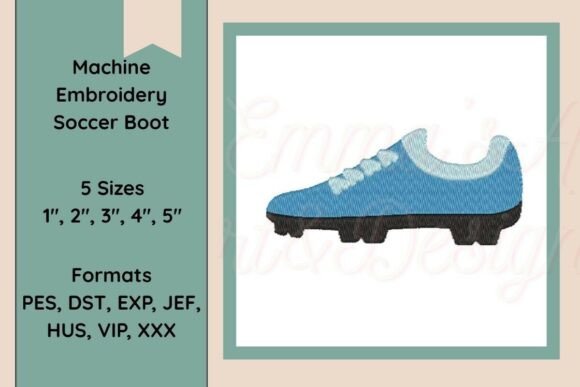
As an embroidery designer who’s developed collections for small clothing brands and Etsy sellers over the past decade, I opened the Soccer Boot Machine Embroidery Design with a clear question: does this feel like a design that elevates a boutique sweatshirt—or just fills space? The answer is encouraging. Visually, it reads as detailed but not overly fussy—clean lines define the boot’s silhouette, subtle texture suggests stitching and lacing without drowning in fill stitches, and the overall shape carries confident, sporty energy. It’s neither cartoonish nor hyper-realistic; instead, it lands in that sweet spot of playful precision: bold enough for chest placement on a hoodie, yet refined enough to pair with minimalist branding. For a Creative Fabrica embroidery file in the Sports category, it avoids cliché—it doesn’t shout “team logo” or lean into mascots. That makes it unusually versatile for custom apparel beyond game day.
How It Performs Across Real Apparel Projects
I tested the Soccer Boot Machine Embroidery Design across several garment types common in small-shop product development: neutral heather grey sweatshirts, soft pastel hoodies, charcoal crewnecks, oversized terry cloth hoodies, lightweight cotton tees, denim jackets, and natural canvas tote bags. On mid-weight fleece and brushed cotton, the design held crispness beautifully—no puckering or thread breakage when stitched at moderate speed. Its moderate stitch density (as implied by its clean visual weight) means it doesn’t overwhelm stretchy fabric or heavy ribbing, though I’d still recommend light cutaway stabilizer for ribbed cuffs or curved hem placements.
For sweatshirt embroidery, it shines at standard chest placement—centered just below the collarbone on a size medium. It also works surprisingly well as a sleeve accent on oversized hoodies, where its directional shape adds subtle narrative movement. As a hoodie design, it balances well on the upper back near the neckline, especially when paired with a tiny coordinating monogram or date. On t-shirts, it reads cleanly at 3.5" wide—large enough to read from across a room, small enough to avoid swallowing the garment’s shape. Denim jackets welcome its structured form, particularly on the left chest or back yoke, where contrast thread (like navy on ecru denim) reinforces its premium feel.
Where Placement Matters—and Where Caution Helps
The Soccer Boot Machine Embroidery Design has thoughtful negative space around the sole and tongue—this helps it breathe on curved surfaces like shoulders or rounded tote bag panels. Still, avoid placing it directly over deep seams, elastic waistbands, or high-stretch side panels unless you’ve pre-tested on identical fabric. Its lacing detail stays legible even at 3", but I wouldn’t shrink it further for tiny lettering applications—this isn’t a monogram file, and forcing scale compromises its personality.
On dark garments, opt for matte thread colors (charcoal, burgundy, forest green) rather than high-sheen metallics—the design’s strength lies in its grounded, tactile quality. For light fabrics, a single layer of tear-away stabilizer suffices; for fleece or terry, go with light cutaway to prevent distortion after washing. Always test on scrap fabric cut from the same bolt—fabric texture changes everything, especially with looped or napped surfaces.
Building Brand Trust Through Thoughtful Embroidery
When your small shop sells handmade product or curated lifestyle apparel, every stitch contributes to perceived value. The Soccer Boot Machine Embroidery Design supports that goal: it looks intentional, not generic. Customers notice when a design feels cohesive—not just “football-themed,” but thoughtfully scaled, balanced, and context-aware. That consistency builds buyer trust, especially for Etsy sellers whose listings rely on visual storytelling. A well-placed Soccer Boot Machine Embroidery Design on a cozy seasonal hoodie signals care in curation—not just speed-to-market.
It also performs strongly in digital contexts: the design translates clearly in printable mockups and social media graphics, retaining legibility even at thumbnail size. That’s critical for small shop product photos where clarity drives clicks. And because it’s distinct without being niche, it fits seamlessly into broader lifestyle collections—think “weekend athlete,” “cozy sports fan,” or “quiet confidence”—not just team merch.
Practical Notes Every Embroidery Designer Should Confirm
- Test before production: Run a sample on scrap fabric pulled from your actual garment batch—dyes, finishes, and tension vary more than we assume.
- Stabilizer choice matters: Light cutaway for fleece, tear-away for cotton tees, and ultra-light fusible for delicate knits.
- Thread color contrast: Review how your chosen thread interacts with fabric texture—matte threads reduce glare on lifestyle product photos.
- Hoop size and placement: Measure your intended location first—some versions may require a 4x4 hoop, others may fit a 5x7. Check the Creative Fabrica product details.
- Inspect stitch density: Zoom in on the digital embroidery file—look for smooth satin columns on the laces and consistent fill angles on the sole. Avoid files with abrupt density shifts.
- Compare placement options: Try the design centered, slightly off-center, and rotated 5°—small adjustments change visual rhythm dramatically on oversized garments.
- Licensing for commercial use: Before selling finished apparel, confirm the Creative Fabrica license permits unlimited physical products—this is essential for Etsy sellers and boutique brands.
Final Thoughts for Creative Entrepreneurs
The Soccer Boot Machine Embroidery Design isn’t just another sports motif—it’s a quietly confident design tool. It works because it respects fabric, scale, and audience. For embroidery shops building custom apparel programs, it’s a reliable anchor piece. For Etsy sellers launching seasonal drops, it adds recognizable charm without limiting appeal. And for small clothing brands curating a signature aesthetic, it offers cohesion across sweatshirts, totes, and jackets—all while feeling fresh, not formulaic. If you’re sourcing machine embroidery design files to strengthen your boutique brand’s visual language, this one earns its place in the working library—not as filler, but as finish.